Signs You May Have a Hidden Water Leak in Your Home
Hidden water leaks rarely announce themselves. Here are the signs Wellington homeowners should watch for, plus how to confirm a leak before it damages your home.
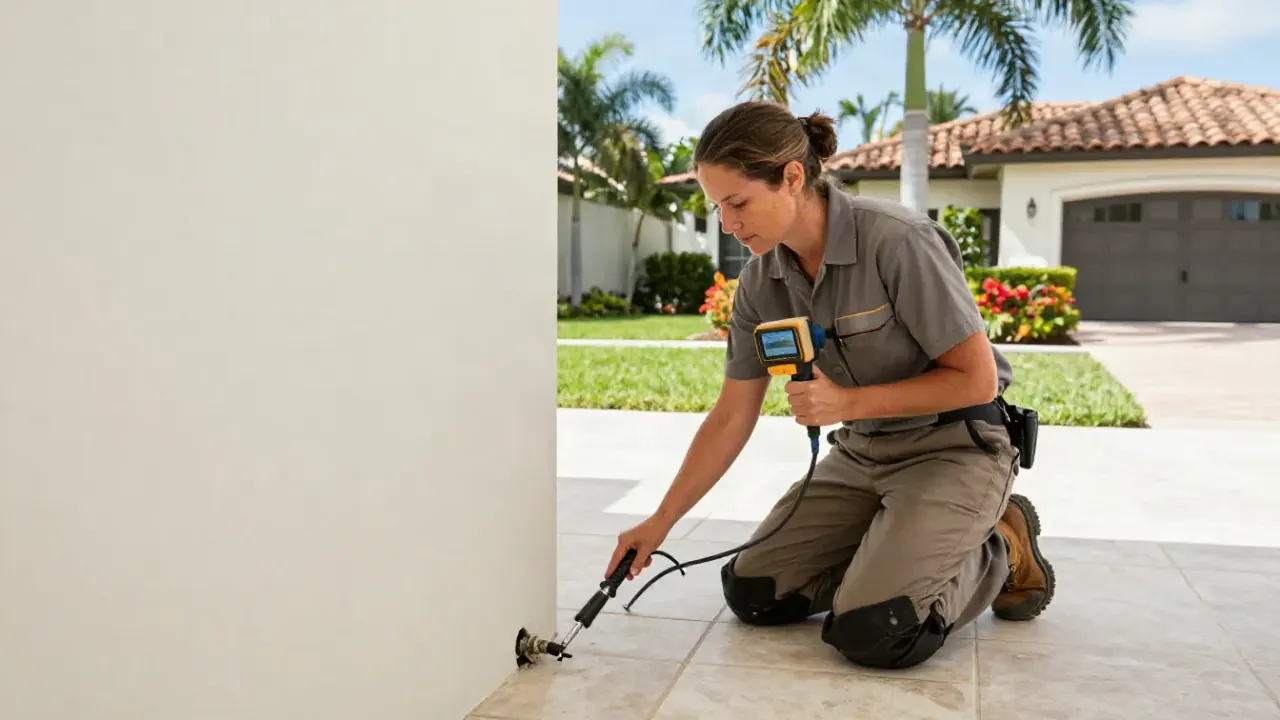
The clearest signs of a hidden water leak in your home are a water meter that keeps spinning with every fixture off, unexplained spikes in your water bill, and warm or damp spots on floors and walls that never seem to dry. If two or more of those are happening at once, you almost certainly have a leak behind a wall, under a slab, or in the service line running to your house. Wellington homes sit on a mix of slab foundations, irrigation-heavy lots, and pool plumbing, so hidden leaks here tend to show up in specific places. This guide walks through the warning signs, a 15-minute meter test you can run yourself, and when it makes sense to bring in a leak detection team.
What a Hidden Water Leak Actually Is
Signs of a hidden water leak in your home Wellington FL homeowners deal with are evidence of water escaping from a pipe, fitting, or fixture that you cannot see with your eyes. The leak is real, the water is running, but the pipe is buried under a slab, tucked inside a wall cavity, or routed underground between the meter and the house.
That is why hidden leaks are so expensive when they go unaddressed. A pinhole leak the size of a pencil tip can waste 10,000 gallons or more in a single quarter. At Wellington's current utility rates, that is a several-hundred-dollar swing on one bill. The water damage behind the wall is usually the bigger cost.
Our team handles Leak Detection Wellington FL work every week, and the pattern is consistent: the leak has usually been running for weeks before anyone calls. The earlier you catch the signs, the cheaper the fix.
The Signs of a Hidden Water Leak in Your Home Wellington FL Homeowners Miss
Water leak warning signs in Wellington FL tend to show up in clusters rather than one at a time. Here are the ones we see most often, roughly in order of how reliably they point to a real leak.
1. Your Water Meter Never Stops Moving
Shut off every faucet, appliance, and irrigation zone. Wait 20 minutes. Look at the low-flow indicator on your meter - the small triangle or dial. If it is still turning, water is moving somewhere in your system. This is the single most reliable sign of a hidden leak, and it takes less than half an hour to check.
2. Your Water Bill Jumped Without a Change in Habits
A sudden 20 to 40 percent increase in your monthly bill with no new pool fill, no extra guests, and no irrigation schedule change is a red flag. Wellington utility customers on the village system often see this before they notice anything else. If your bill has climbed two cycles in a row, book a Water Meter and High Water Bill Investigation Wellington FL before the next one lands.
3. Warm Spots on the Floor
If you have a slab foundation - common in Wellington's established neighborhoods - a hot spot on the tile or carpet is often a hot water line leaking under the slab. The warm water saturates the soil and concrete and radiates up. Barefoot test: walk the floor in the morning before the sun hits it. A patch that feels warmer than the rest is worth investigating.
4. Damp, Discolored Walls and Baseboards
Paint that bubbles, drywall that feels soft, or baseboards that pull away from the wall all point to moisture behind the surface. In Wellington's humidity, these symptoms can also come from AC condensation, so the tell is location. If the dampness is on an interior wall far from any AC closet or vent, it is almost always plumbing.
5. A Musty Smell That Will Not Go Away
That earthy, wet-cardboard smell in a closet, hallway, or bathroom is mold or mildew feeding on moisture. If you have cleaned, ventilated, and it still comes back within a week, the moisture source is ongoing. Hidden leaks and mold go together more often than not.
6. Cracks in Tile, Drywall, or Foundation
New hairline cracks in floor tile, a crack running up the drywall from a corner, or a visible crack in the slab itself can all be caused by soil shifting under a slow leak. Wellington sits on sandy soil and limestone, and long-running leaks change how that soil behaves under a foundation.
7. The Sound of Running Water When Everything Is Off
Stand in a quiet room at night. If you hear a faint hiss, drip, or trickle with all fixtures off, water is moving. This is one of the easiest signs to check and one of the most overlooked.
8. A Pool That Needs Constant Topping Off
Wellington has thousands of pools, and a pool losing more than a quarter inch of water per day in cool weather - or more than an inch in summer - is losing it somewhere. Evaporation is real, but a bucket test will separate evaporation from a leak. If the pool loses more than the bucket, the pool shell or plumbing is leaking.
How Can I Tell If I Have a Hidden Water Leak?
You can confirm a hidden leak in about 15 minutes with three checks: the meter test, the bill comparison, and a visual sweep of the house. Run them in that order - the meter test is the most definitive.
- Meter test. Turn off all water inside and outside the house. Note the meter reading. Wait 20 minutes. Read again. Any movement means a leak.
- Bill check. Pull the last three months of bills. A steady climb with no usage change is a strong signal.
- Visual sweep. Walk the perimeter, check under every sink, look at the water heater pan, and inspect the pool equipment pad for wet spots.
If the meter is moving and you cannot find the source, the leak is hidden - behind a wall, under the slab, or underground. That is when the tools we use (acoustic listening, thermal imaging, and pressure testing) start to matter. If you suspect the leak is in the main line coming into the house, we run a Water Service Line Leak Location Wellington FL to pinpoint it without digging up the whole yard.
Where Hidden Leaks Hide in Wellington Homes
Hidden leak detection in Wellington, Florida is a bit different from other parts of Palm Beach County because of the housing mix. We work on everything from 1980s ranch homes to newer builds in the equestrian communities, and the leak locations follow the construction style.
Under the Slab
Slab leaks are the most common hidden leak we find in Wellington's older single-family neighborhoods. Copper and older galvanized lines under the concrete eventually fail at joints or from pinhole corrosion. Signs: warm floor spots, unexplained high bills, and a meter that never stops. Locating a slab leak without breaking up the whole floor takes acoustic and thermal equipment - that is the whole point of Slab Leak Location Wellington FL.
Inside Walls and Ceilings
Supply lines running through wall cavities and drain lines in ceilings are the second most common. A slow supply leak shows up as a damp patch. A drain leak shows up as a stain that grows after every shower. Ceiling stains that reappear after a rain are usually roof; stains that appear after plumbing use are plumbing. We trace both with Ceiling and Wall Leak Tracing Wellington FL.
In the Yard and Irrigation System
Wellington lots are irrigated heavily, and irrigation lines fail at fittings, valves, and heads. A zone that runs but never seems to water the lawn, or a soggy patch that stays wet two days after the sprinklers run, is a leak. Underground pipe leaks between the meter and the house fall in the same category. Both are located with Underground Pipe Leak Location Wellington FL before anyone starts digging.
Around Pools and Spas
Pool plumbing, spa jets, and autofill lines leak quietly. A pool that needs topping off every few days, a pump that loses prime, or a wet spot on the equipment pad all point to a leak in the pool system. We handle Pool and Spa Leak Location Wellington FL with pressure testing and dye testing so we know exactly which line is failing.
In the Equestrian and Gated Communities
Homes in the equestrian corridor and the gated communities around Wellington tend to have longer service lines, more irrigation zones, and more outdoor plumbing - which means more places for a leak to hide. We regularly work in Leak Detection in Equestrian Club and the surrounding communities, where a leak in a barn line or a long driveway run can go unnoticed for months.
What to Watch Out For: Common Mistakes
Most of the expensive hidden leak stories we hear start with one of these mistakes. Avoiding them saves real money.
- Waiting for visible damage. By the time you see a stain or a soft floor, the leak has usually been running for weeks. The meter test costs you 20 minutes.
- Assuming a high bill is a billing error. Call the utility and ask, but run the meter test the same day. If the meter moves, it is not a billing problem.
- Cutting into drywall to "find it." Opening walls at random is expensive and usually wrong. Acoustic and thermal tools find the leak first, then we open one small section.
- Ignoring a warm floor spot. A hot water slab leak heats the whole slab over time and can warp flooring. It does not fix itself.
- Letting a pool leak ride. A pool losing an inch a day can drop the water below the skimmer in a week and burn out the pump. That is a several-hundred-dollar repair on top of the leak.
- Treating mold as the problem. Mold is a symptom. If you kill the mold but do not fix the leak, it comes back in a month.
When to Call a Professional
Call a leak detection professional when the meter test shows movement and you cannot find the source, when your bill has climbed two cycles in a row, or when you see dampness, warm spots, or new cracks that were not there last season. Those are the three triggers.
You do not need to wait for visible damage. In fact, the cheapest leak repairs happen before the damage starts. Our team at Wellington Leak Detection uses acoustic listening, thermal imaging, and pressure testing to find hidden leaks without tearing your home apart. We locate the leak first, show you where it is, and then fix it - one visit, one clear price.
If you are in one of the village's gated communities, we also work regularly in Leak Detection in Olympia and similar neighborhoods where HOA rules affect how and when we can access exterior lines. We know the drill and handle the coordination.
Frequently Asked Questions
What are the signs of a hidden water leak in my home in Wellington FL?
The top signs are a water meter that keeps moving with all fixtures off, a water bill that jumped 20 percent or more with no usage change, warm spots on the floor, damp walls or baseboards, and a musty smell that returns within a week of cleaning. Two or more together almost always mean a real leak.
How can I tell if I have a hidden water leak?
Run the meter test. Turn off every fixture and irrigation zone, note the meter reading, wait 20 minutes, and read it again. Any movement means water is escaping somewhere. If you cannot find the source visually, the leak is hidden and needs professional detection equipment.
Does a hidden water leak always cause mold in Wellington?
No. Mold needs moisture plus organic material plus time - usually 24 to 48 hours of continuous dampness. A fast-draining slab leak may never grow mold, while a slow wall leak can grow it in under a week. Wellington's year-round humidity speeds that timeline up considerably.
Who do I call for hidden water leak detection in Wellington?
Call a dedicated leak detection company, not a general handyman. Locating a hidden leak requires acoustic listening, thermal imaging, and pressure testing equipment. Wellington Leak Detection handles both the location and the repair, so you are not paying two companies for one problem.
How much does hidden leak detection cost in Wellington in 2026?
Typical 2026 pricing in this area runs $250 to $450 for a standard residential leak location, depending on how many systems need testing. Slab, pool, and underground line locations sit at the higher end. The repair is quoted separately once we know what we are dealing with.
Get Help with Leak Detection in Wellington
If any of the signs above sound familiar, do not wait for the damage to show up on your floor or your next bill. We find the leak, fix it, and test the line before we leave.
Call Wellington Leak Detection at (561) 760-4218 and we will get a technician out to your home.