What Is a Slab Leak and Why Are They Common in Florida
A slab leak is a water pipe failure beneath your concrete foundation. Here's why Florida's soil, heat, and plumbing codes make them so common in Wellington.
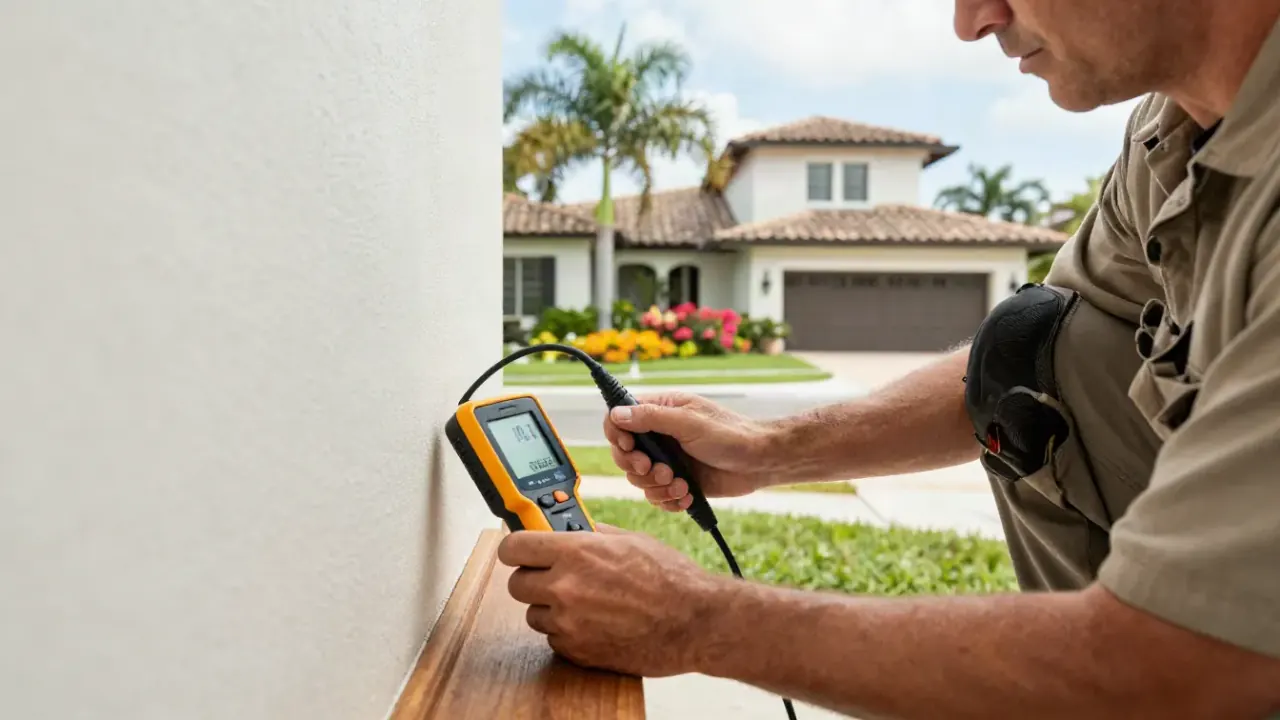
A slab leak is a water pipe failure beneath your home's concrete foundation, and it's common in Florida because most homes here are built on slab-on-grade foundations with copper or CPVC supply lines buried directly in or under that concrete. Wellington sits on sandy, shifting soil that expands and contracts with our wet and dry seasons, and that movement stresses buried pipes until they crack. Over the next few sections we'll cover exactly what causes these leaks, how to tell if you have one, and what detection and repair look like in 2026.
What a Slab Leak Actually Is
A slab leak is a pressurized water supply line failure that occurs underneath the concrete slab your home sits on, which means the water escapes into the soil or up through the slab rather than into a visible cabinet or wall. In Florida, that supply line is almost always copper or CPVC, running from where the main enters the house to each fixture. When one of those lines fails, you don't see a dramatic burst - you see a hot spot on the floor, a water bill that jumped $80 to $200 in a single month, or the faint sound of running water when every tap is closed.
There are three general types. A line break is a full split in the pipe. An abrasion leak happens when the pipe rubs against rebar, gravel, or another pipe for years until the wall thins. A pinhole leak is a tiny puncture, often from corrosion, that sprays a fine mist into the soil. All three behave the same way from your side of the slab: hidden, slow, and expensive if ignored.
Why Are Slab Leaks So Common in Florida?
Slab leaks are common in Florida because of the combination of slab-on-grade construction, aggressive soil chemistry, and year-round ground movement - three conditions that work against buried copper and CPVC. Wellington sits in western Palm Beach County, where the soil is a mix of sand, shell, and muck that holds moisture unevenly. During our May-to-October rainy season the ground swells. From November through April it dries and shrinks. Every cycle nudges the pipes under your slab.
Copper is especially vulnerable here. Florida's sandy soil is often slightly acidic, and the chloramines used in local water treatment accelerate the process. A copper line that would last 50 years in a neutral-soil state can develop pinholes in 15 to 20 years in Wellington. CPVC holds up better against corrosion but becomes brittle over time, especially in homes built before 2005 when the formulation was different.
Hot water lines fail first. They expand when heated and contract when they cool, and that daily cycle - dozens of times a day in a busy household - is what eventually cracks the pipe. If your slab leak is on the hot side, you'll often notice a warm spot on the tile before you notice anything else.
We also see a cluster of slab leaks in neighborhoods with older infrastructure. Across Leak Detection in Palm Beach Polo, for example, many homes were built in the 1980s and 1990s and are now well into the window where original copper lines start failing. The same pattern shows up in established Wellington communities where the original plumbing has never been replaced.
How Do I Know If I Have a Slab Leak in Wellington?
You know you likely have a slab leak in Wellington when you find a warm spot on the floor, hear running water with all fixtures off, or see a water bill that jumped by more than 20 percent with no change in usage. Those are the three signals we hear most often from homeowners calling us for the first time.
Here's what to check before you call anyone:
- Shut off every fixture - faucets, toilets, irrigation, pool autofill, ice maker - and watch your water meter for 10 minutes. If the low-flow dial still moves, you have a leak on the pressurized side.
- Walk the floors barefoot. A warm or hot patch on tile or wood usually means a hot-water slab line is leaking underneath.
- Listen at night. With the house quiet, put your ear near the floor in each room. A faint hiss or trickle is often a pinhole spraying into soil.
- Check the water bill history. A family of four in Wellington typically uses 4,000 to 6,000 gallons a month. A slab leak can add 3,000 to 10,000 gallons to that number.
- Look for cracks or mildew along the baseboard, at the slab edge, or in a closet floor. Water under a slab has to go somewhere.
If two or more of those check out, stop running water and call for detection. Every day a slab leak runs, you're paying for water that's soaking into the ground under your house, and in some cases you're also undermining the soil support under the slab.
How We Detect a Slab Leak in Wellington, Florida
We detect a slab leak in Wellington, Florida without breaking your floor open. That's the whole point of modern leak detection - find the exact spot first, then cut once. Our process starts with isolating the system: we shut off the main, pressurize the supply lines, and watch how the pressure holds. That tells us whether the leak is on the hot side, the cold side, or the service line coming in from the meter.
From there we use acoustic listening equipment to hear the leak through the slab, thermal imaging to spot temperature differences on the floor surface, and in some cases a small access point to confirm with a camera. For homes where the leak is on the incoming main rather than under the slab itself, we run a separate Water Service Line Leak Location Wellington FL inspection to pinpoint the break between the meter and the house.
Once we know the location, we give you a straight answer on repair options. Sometimes the fix is a spot repair - jackhammer a 2-by-2-foot section, cut out the failed pipe, replace it, and pour new concrete. Sometimes it's a reroute through the attic or walls, which avoids breaking the floor entirely. We'll tell you which one makes sense for your house and your budget.
What Slab Leak Repair Costs in 2026
Slab leak repair in Wellington in 2026 typically runs $1,200 to $4,500 depending on how the leak is fixed and how much concrete has to be opened. Detection alone - the acoustic, thermal, and pressure work - usually runs $350 to $650 and is often credited toward the repair if you hire us to do the work.
Here's a rough breakdown of what drives the number:
- Spot repair with concrete break-out: $1,200 to $2,500. Best when the leak is in an open area like a hallway or garage.
- Reroute through attic or walls: $2,000 to $4,500. Avoids breaking tile or hardwood and is often the better long-term choice in finished rooms.
- Repipe of the affected zone: $3,500 to $8,000. Worth considering if the pipe has already failed once and is showing other signs of age.
- Water damage remediation (if the leak has been running a while): $500 to $3,000 depending on how much flooring, drywall, or cabinetry is affected.
Homeowner's insurance in Florida sometimes covers the water damage but rarely covers the pipe repair itself. We'll give you a written scope you can hand to your adjuster if you decide to file a claim.
What to Watch Out For
The biggest mistake we see is homeowners waiting. A slab leak doesn't heal, and it doesn't stay the same size. A pinhole becomes a split. A damp spot becomes a buckled floor. A $400 detection turns into a $6,000 remediation because the leak ran for three months behind a cabinet.
Other things to watch:
- Don't trust a $99 "leak detection special." Real detection takes equipment and time. If the price sounds like a coupon, it's usually a sales visit for a repipe.
- Don't assume it's the pool. Pool and irrigation leaks are common in Wellington, but so are slab leaks, and the symptoms overlap. If your pool is losing water and your meter is spinning, you may have two problems.
- Don't ignore a warm floor in summer. It's easy to blame the Florida heat. A hot spot that's warmer than the surrounding tile is a hot-water slab line, not the sun.
- Don't patch the symptom. Painting over a mildew stain or replacing a buckled board without finding the source just delays the real repair.
If you're not sure whether you're looking at a slab leak or an irrigation problem, we also handle Irrigation and Sprinkler Line Leak Tracing Wellington FL and can rule one out before we go further.
When to Call a Professional
Call a professional the moment your water meter moves with everything off, or the day you find a warm spot on the floor. Those two signs are about as close to a confirmed slab leak as you'll get without equipment, and both mean water is actively escaping under your foundation.
We're Leak Detection Wellington FL, and we handle slab leaks, service line leaks, and everything in between for homeowners across western Palm Beach County. Our team uses acoustic and thermal detection to find the leak before anyone touches your floor, and we give you a flat price on the repair before we start. If you're in one of the equestrian communities off South Shore or Pierson, we're in your neighborhood regularly - including Leak Detection in Equestrian Club, where larger lots and longer service line runs make detection especially valuable.
Frequently Asked Questions
What is a slab leak in Wellington FL?
A slab leak in Wellington FL is a water supply pipe failure beneath your home's concrete foundation. It's usually caused by soil movement, corrosion, or thermal expansion on copper or CPVC lines. You'll typically notice it as a warm floor spot, a running-water sound, or a water bill jump of 20 percent or more.
Why are slab leaks common in Florida?
Florida's slab-on-grade construction, sandy acidic soil, and wet-dry seasonal ground movement all stress buried pipes. Copper lines that would last 50 years elsewhere often fail in 15 to 20 years here. Hot-water lines fail first because of daily expansion and contraction.
How do I know if I have a slab leak in Wellington?
Shut off every fixture and watch your water meter for 10 minutes - if it still moves, you have a pressurized leak. Other signs: a warm spot on the floor, a hissing sound at night, or a water bill that jumped by 3,000 gallons or more in a month.
What should I do if I suspect a slab leak in Wellington?
Stop running water, shut off the main if you can, and call for professional detection. Don't break the floor open yourself - you'll likely miss the leak and create a bigger repair. Detection typically costs $350 to $650 and pinpoints the exact spot before any concrete is cut.
Get Help with Leak Detection in Wellington
If your meter is spinning with everything off, or you've found a warm spot on the floor, we can be at your door and find the leak the same day. Call Wellington Leak Detection at (561) 760-4218 and we'll pinpoint the break before anyone touches your slab.